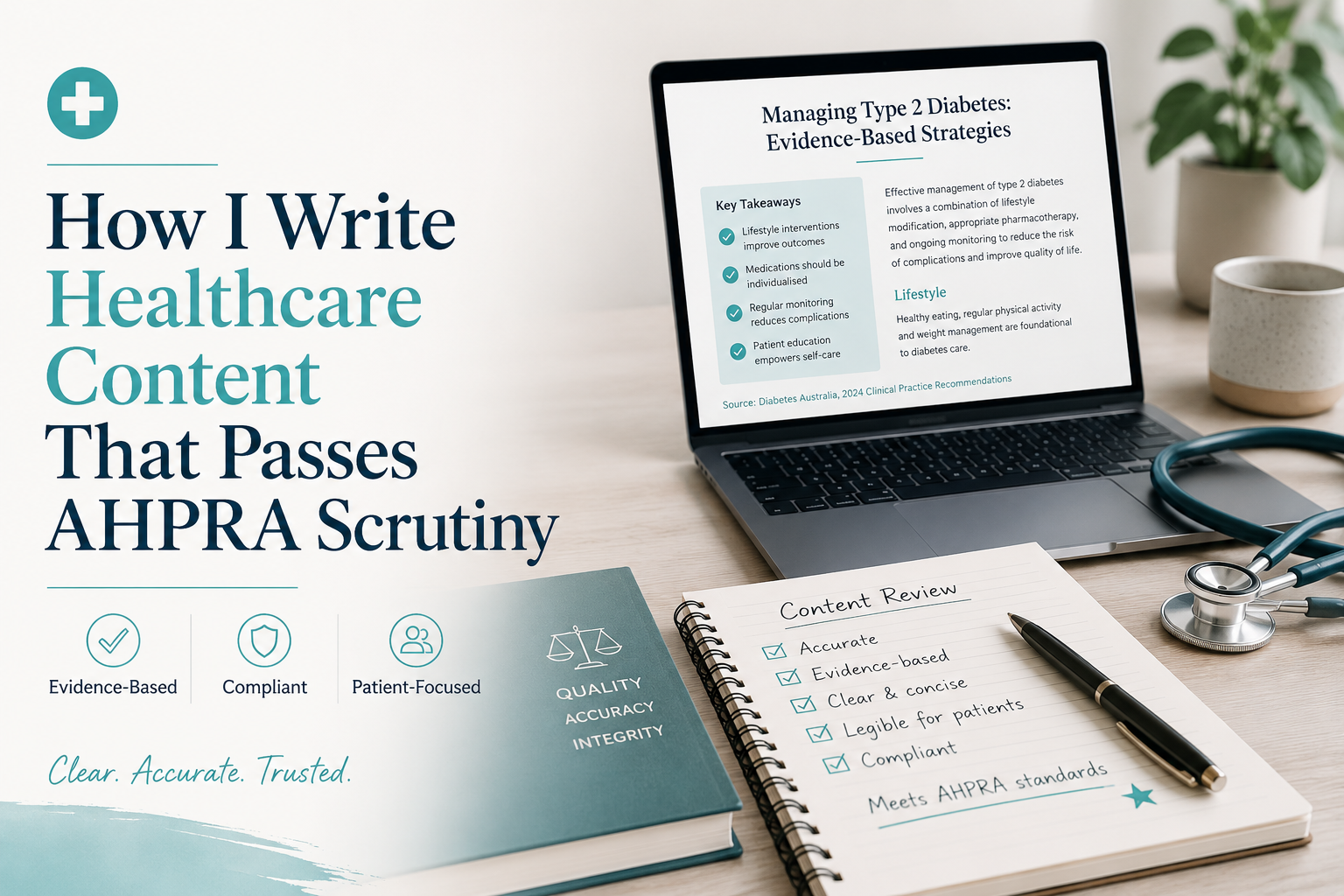
Writing content for the Australian healthcare and telehealth sector isn’t just about engagement or SEO rankings—it is about patient safety, legal compliance, and medical integrity. In Australia, medical marketing and informational copy are strictly regulated by the Australian Health Practitioner Regulation Agency (AHPRA) and the Therapeutic Goods Administration (TGA).
One wrong phrase or an unsubstantiated clinical claim can land a medical practice, telehealth platform, or digital health brand in serious regulatory jeopardy.
When clients hire me to write their healthcare content, I don’t just write to appease search engine algorithms; I write to pass strict clinical and legal scrutiny. Here is an inside look at my exact framework for crafting high-performing, fully compliant Australian medical content.
1. Grounding Everything in “Evidence-Based” Reality
Under AHPRA guidelines, any health reflection, treatment claim, or clinical benefit mentioned in your content must be backed by reliable, peer-reviewed, objective data.
When I build out content, I eliminate ambiguous buzzwords like “miracle cure,” “100% guaranteed results,” or “effortless recovery.” Instead, I anchor statements using high-authority data points. In practice, this means:
- Sourcing statistics directly from peak bodies like the Australian Department of Health and Aged Care.
- Citing clinical trials, NHMRC guidelines, or established medical journals.
- Framing outcomes transparently (e.g., using phrases like “Clinical studies indicate…” rather than “This treatment will…”).
2. Navigating TGA Compliance and Therapeutic Claims
The TGA regulates therapeutic goods, including medicines, medical devices, and health supplements. A common pitfall for many content writers is advertising a regulated service or product with unapproved therapeutic claims.
To maintain strict TGA compliance, my writing process ensures that:
- No Restricted Representations: We never imply that a service or product can prevent, cure, or alleviate serious health conditions (like cancer, cardiovascular diseases, or mental health crises) unless explicitly permitted under TGA legislation.
- Separation of Prescription Copy: For telehealth sites, referencing specific prescription-only medicines (Schedule 4 and Schedule 8 drugs) on public-facing promotional pages is highly restricted. I focus the copy on the consultation service and the access to qualified medical professionals, rather than the medication itself.
3. Implementing Bulletproof YMYL and E-E-A-T Signals
Google categorises health content under Your Money or Your Life (YMYL), meaning it applies the highest standards of Experience, Expertise, Authoritativeness, and Trustworthiness (E-E-A-T).
To satisfy both search engines and medical boards, I structure every healthcare piece with explicit trust signals:
- Author/Reviewer Bylines: Ensuring copy includes a clear note showing it has been reviewed by an Australian-registered health practitioner.
- Recent Date Stamps: Marking content with “Last Updated” metrics to prove information reflects current Australian clinical guidelines.
- Hyper-Localized Context: Aligning health advice with local resources, such as pointing readers to Healthdirect Australia for reliable symptom checking.
4. The Anatomy of a Compliant Disclaimer Structure
A premium piece of Australian medical copy is incomplete without an appropriate, unambiguous disclaimer. AHPRA requires that educational content is never mistaken for direct, personalised medical advice.
Every healthcare landing page or pillar blog I write includes a strategically positioned, legally sound disclaimer. It looks something like this:
Disclaimer: The information provided on this website is intended for general educational and informational purposes only. It does not constitute personal medical advice, diagnosis, or treatment. Always seek the advice of a qualified Australian health practitioner (such as your GP) regarding any medical condition or health objectives. If you are experiencing a medical emergency, please call 000 immediately.
Why This Discipline Matters for Your Brand
By combining rigorous SEO keyword alignment with a deep respect for AHPRA and TGA boundaries, I deliver content that protects your clinical reputation, mitigates legal risk, and builds authentic trust with Australian patients.