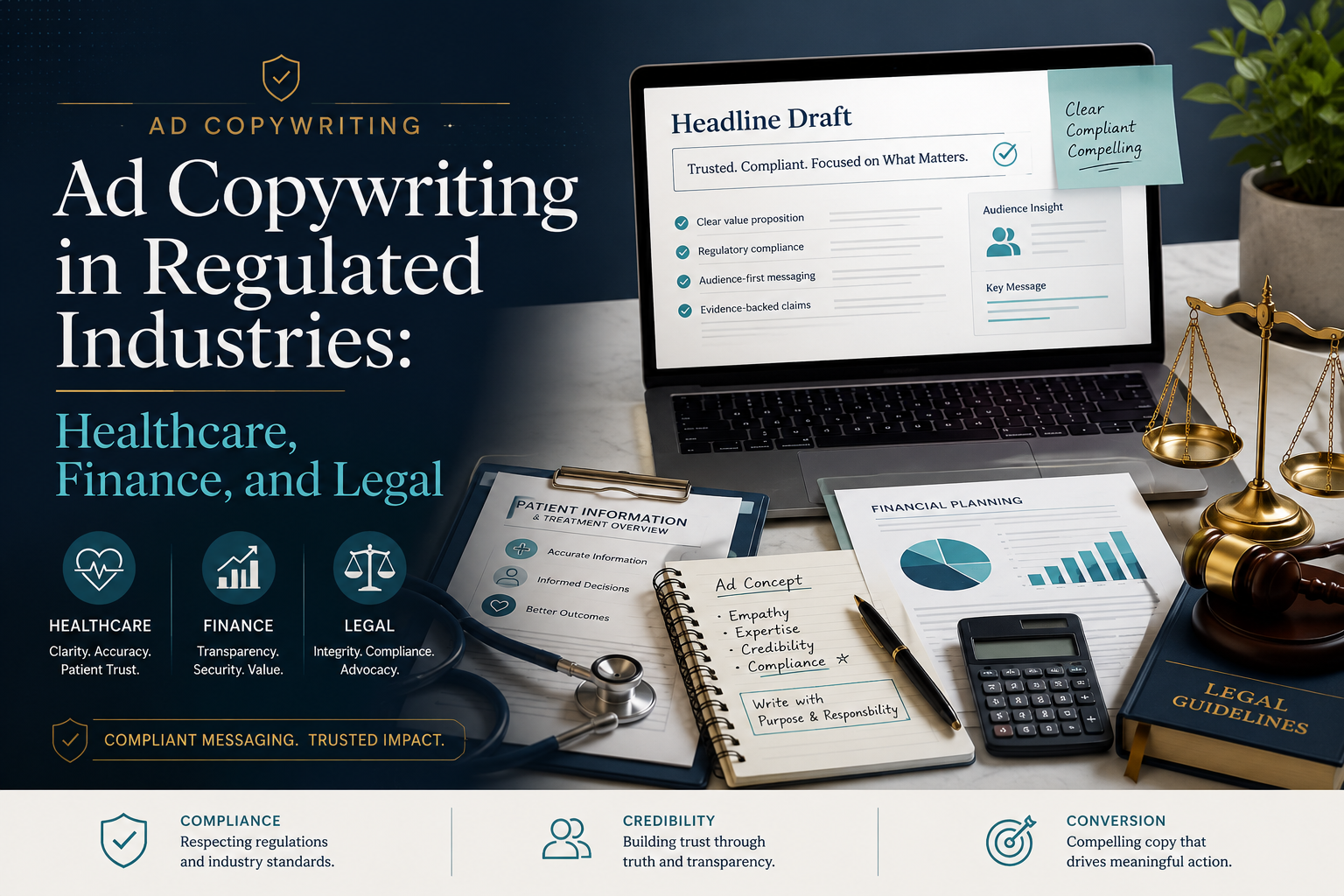
Writing ad copy for a standard e-commerce brand or a generic B2B SaaS platform is relatively straightforward: you find the pain point, amplify the emotional trigger, make a bold claim, and drop an aggressive call-to-action.
But try that exact same formula in healthcare, finance, or legal services, and your ad accounts will be flagged, suspended, or permanently banned before the day ends.
Operating in regulated industries means balancing performance marketing with strict consumer protection laws. In Australia, this means writing copy that satisfies the rules of the Therapeutic Goods Administration (TGA), AHPRA, the Australian Securities and Investments Commission (ASIC), and the Australian Competition and Consumer Commission (ACCC)—all while staying within Meta and Google’s automated ad compliance policies.
Here is my playbook on how to write highly compelling, restriction-proof ad copy when the regulatory stakes are incredibly high.
1. Healthcare Ads: Shifting from “The Product” to “The Access.”
When running Meta or Google ads for clinics or telehealth platforms, the automated compliance bots are hyper-sensitive to health attributes and specific medical claims. Meta’s policy explicitly bans copy that implies or asserts personal attributes, such as medical conditions.
- The Violation: “Are you struggling with chronic anxiety? Try our online clinic today.” (Implying a personal medical condition).
- The Compliant Shift: “Access private telehealth consultations with Australian-registered GPs from the comfort of home.” (Focusing on the convenience of the service, not the illness).
Furthermore, advertising prescription-only medications is illegal under TGA guidelines. If you are writing copy for a brand that facilitates weight management or medicinal cannabis, you can never mention the specific substance name in the ad text or the headline. The copy must focus entirely on the medical evaluation process and access to accredited practitioners.
2. Financial Copy: Navigating Risk and Truthful Outcomes
Financial services, including fintech apps and mortgage brokerages, are heavily scrutinized under ASIC guidelines to prevent misleading or deceptive conduct. In financial copywriting, you cannot make absolute, unverified guarantees regarding monetary gains, approval success, or timeline commitments.
When writing high-converting financial ad hooks, I replace vague, over-promising claims with compliant, transparent framing:
| High-Risk Copy (Banned/Flagged) | Safe, Compliant Translation |
| “Guaranteed low interest rates for your home loan.” | “Compare current Australian interest rates from over 30+ lenders.” |
| “Double your investment returns in 6 months with our app.” | “Build a diversified portfolio using automated, data-driven insights.” |
| “Get instant approval on your commercial loan today.” | “Check your loan eligibility online without impacting your credit score.” |
Additionally, whenever financial products are advertised, appropriate risk warnings or links to Product Disclosure Statements (PDS) must be seamlessly integrated into either the ad copy or the primary landing page destination.
3. Legal Services: Conveying Expertise Without Creating False Hope
Legal advertising, particularly for personal injury, family law, or class actions, carries strict state-by-state statutory restrictions across Australia (such as the Legal Profession Uniform Law). Copywriters often fall into the trap of writing overly sensationalist copy that creates unrealistic expectations.
- Avoid: “We win every case. Get the maximum cash payout you deserve.”
- Employ: “Navigate your legal rights with a dedicated, experienced team. No-win, no-fee options available for eligible cases.”
The focus should always remain on clarity, guidance, and accessibility, positioning the practitioner or firm as a trusted, objective guide rather than an aggressive equalizer.
4. Beating the Meta and Google Compliance Algorithms
To keep your ad accounts completely safe across platforms, I rely on three foundational rules of compliance copy:
- Third-Person Framing: Keep the copy centered on the system or the service rather than using direct personal pronouns like “you,” “your,” or “yours” when discussing sensitive problems.
- Avoid Shock Value: Do not use sensationalized punctuation, capitalization, or fear-mongering hooks (e.g., “CRITICAL HEALTH WARNING!”).
- Destination Alignment: Ensure your ad copy matches the exact messaging of the landing page. If the bot detects a mismatch between your ad’s framing and your final landing page disclaimers, the ad will instantly face rejection.
The Expert Advantage
Compliance shouldn’t kill your creativity; it should refine it. Writing high-performing copy within regulatory restrictions requires deep discipline and precision. When your ads are written with a thorough understanding of Australian advertising laws, you eliminate costly account downtime and build an authoritative, unbreakable brand.