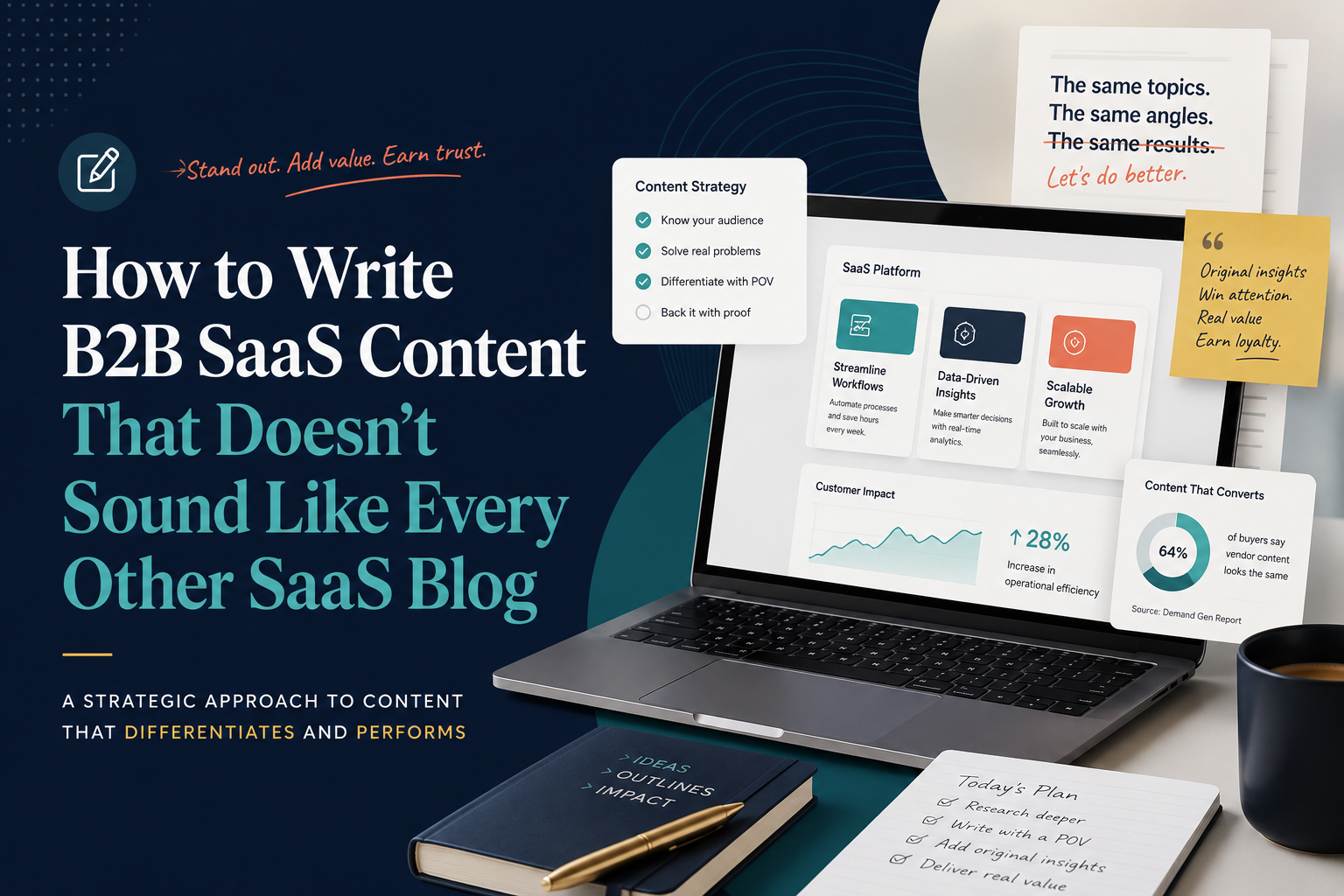
If you spend ten minutes browsing the blogs of five different B2B software companies in almost any niche, you will notice something incredibly painful: they all sound the same.
Most B2B SaaS content has devolved into a sea of generic, AI-generated fluff. It is filled with bloated corporate buzzwords like “synergize workflows,” “streamline operational efficiencies,” and “optimize paradigm shifts.” This type of writing doesn’t educate the reader, it doesn’t solve a tangible business problem, and it certainly doesn’t convert a high-intent decision-maker.
When a Chief Technology Officer (CTO) or operations director searches for a software solution, they aren’t looking for an essay on “Why Collaboration Matters.” They are looking for direct answers, technical comparisons, and proof of ROI.
If you want your SaaS content strategy to drive actual pipeline growth and capture high-authority backlinks from major industry publications, you have to break away from the generic playbook. Here is how I approach B2B SaaS writing to ensure it stands completely out from the noise.
1. Dismantling the “Feature-Driven” Trap
The most common mistake generalist writers make when handling technical software products is writing exclusively about features. They list what the product does like a dry product manual, completely failing to connect those mechanics to the real-world operational realities of the buyer.
To write high-converting SaaS content, you must master the Feature-to-Outcome translation. You must explain the underlying technology, but instantly anchor it to a measurable metric that a business leader actually cares about.
- The Lazy Feature Statement: “Our platform features real-time, automated API webhook integrations with major CRM systems.”
- The Outcome-Driven Copy: “Our direct CRM webhooks eliminate manual data entry, cutting down lead-to-call response times from 45 minutes to less than 60 seconds.”
2. Structuring Unbiased, High-Converting Comparison Pages
One of the highest-intent traffic channels for any B2B software platform is the “Alternative” or “Comparison” search query (e.g., Brand A vs Brand B). Most brands approach these pages with aggressive bias, making themselves look like a flawless savior while painting their competitor as completely useless.
Modern B2B buyers see right through this. The fastest way to build trust and capture conversions on a product comparison page is to present an honest, objective framework.
When I draft comparison copy, I build a clear, transparent matrix based on ideal use cases rather than generic superiority:
| Feature/Capability | Our Platform | Legacy Competitor |
| Ideal For | High-volume, fast-scaling enterprise teams requiring advanced API customisation. | Small-to-medium businesses looking for a simple, out-of-the-box interface. |
| Deployment Speed | 2-4 weeks (Requires brief technical onboarding). | Instant setup (Limited custom fields). |
| Data Residency | 100% Australian cloud hosting (Meets local medical & financial compliance). | Global multi-tenant hosting (Primarily US-based servers). |
By openly admitting who your product is not for, you make your arguments about who it is for exponentially more persuasive.
3. Writing for the Technical Buyer vs. the Economic Buyer
A major pitfall in B2B SaaS content is forgetting that a single piece of content often has to satisfy two entirely different readers within a company’s purchasing committee:
- The Technical Buyer (The End User): This reader wants to know about integration stability, data schema flexibility, microcopy design, and API documentation. They care about how it works.
- The Economic Buyer (The Executive): This reader wants to know about implementation downtime, cost reduction metrics, team adoption rates, and customer support availability. They care about the bottom line.
My writing framework balances both worlds within a single article. I pair technical, precise terminology (showing deep domain authority) with clear executive summaries and operational takeaways that can be easily copied and pasted directly into an internal procurement deck.
4. The Anatomy of an Integration & Ecosystem Post
If your SaaS app integrates with major tools like HubSpot, Salesforce, or Xero, writing generic “We integrate with X” pages is a massive wasted opportunity. To stand out and win natural backlinks from those ecosystem partners, your integration content must read like a tactical blueprint.
Instead of writing a basic list, I map out the explicit, programmatic relationship between systems:
- The Trigger: Explain the specific user action in the primary platform.
- The Data Transfer: Explicitly outline what fields are synced securely in the background.
- The Result: Detail the final automated action that saves the customer hours of manual labor.
Writing Content That Drives Revenue
B2B SaaS decision-makers are incredibly busy people who protect their time fiercely. They do not want to read generic paragraphs that restate the obvious. By stripping out the corporate jargon, leaning into honest feature comparisons, and speaking directly to both the operational and economic realities of your target buyer, you transform your blog from an empty traffic counter into a robust, authoritative customer acquisition machine.