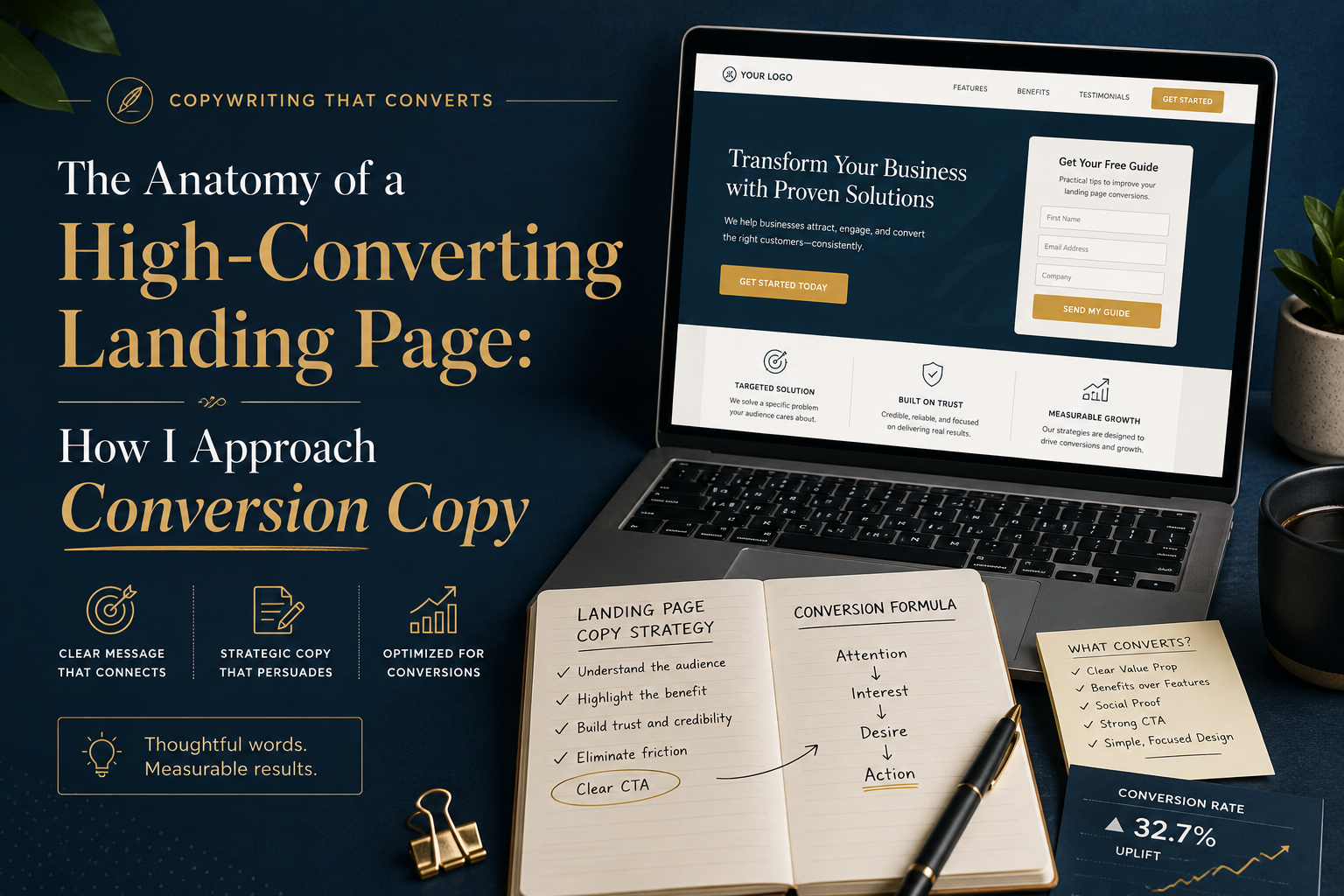
Beautiful web design can get a user to stay on a page, but it is the copy that gets them to take action. Far too often, brands spend thousands of dollars driving paid traffic from Google Ads or Meta to a beautifully designed landing page, only to wonder why their conversion rates are sitting at a dismal 1%.
The culprit is almost always a breakdown in conversion copywriting.
When I design and write a landing page, I treat it as a structured, psychological conversation with the reader. Every sentence must earn its place, and every section must systematically dismantle a user’s hesitation.
Here is the exact visual and psychological framework I use to build high-converting landing pages from scratch.
1. The Above-the-Fold Framework (The Hero Section)
The space before a user scrolls is your only chance to make a first impression. Within less than five seconds, a visitor needs to know exactly what you offer, how it solves their problem, and what to do next.
My hero copy always consists of three distinct elements:
- The Hook (Headline): This focuses entirely on the primary value proposition or the biggest outcome the user desires. No vague, poetic statements.
- The Context (Sub-headline): A structural 2-3 sentence block that explains how the promise is delivered and eliminates immediate friction.
- The Primary Action (CTA): A prominent button with high-contrast positioning and action-oriented copy (e.g., “Get My Custom Audit” instead of “Submit”).
2. The Proof Block (Building Immediate Trust)
Before you ask a reader to scroll deeper or buy into your features, you must establish credibility. Users are inherently cynical online.
Right below the hero section, I position an immediate trust signal or proof block. This isn’t the place for a long case study; instead, it’s a visual anchor showing:
- As-seen-on media logos or industry certifications.
- A high-impact data point (e.g., “Trusted by over 14,000+ Australian clinic managers”).
- A single, powerful, punchy customer quote that highlights a massive transition from pain to relief.
3. The Feature-to-Benefit Translation Matrix
This is where most standard copywriting fails. Brands love listing what their product or service does (features) rather than what it means for the customer (benefits).
When structuring the body copy of a landing page, I map out a clear hierarchy where every feature is immediately anchored to an emotional or operational benefit:
| Feature (What it is) | Benefit (What they get) |
| Automated text reminders | Eliminates manual admin tasks and drops appointment no-shows by up to 40%. |
| AHPRA & TGA compliant checks | Removes the risk of regulatory fines and legal scrutiny, keeping your brand safe. |
| 256-bit data encryption | Guarantees absolute patient privacy and builds institutional bank-level trust. |
4. Systematic Objection Handling
A premium conversion copywriter doesn’t ignore the reasons why a customer might say “no”—they actively address them in the copy. Near the bottom third of the page, right before the final pitch, I design an objection-handling zone.
This can be seamlessly woven into a strategically written Frequently Asked Questions (FAQ) section or structured as a standalone “Why Choose Us” block. I systematically write copy to tackle:
- Price resistance: Framing the cost as an investment vs. an expense.
- Risk anxiety: Introducing clear risk-reversal triggers like guarantees or contract-free models.
- Implementation friction: Showing how easy it is to get started (e.g., “Onboarding takes less than 10 minutes”).
5. The Secondary and Final CTA Call
As the user reaches the end of the psychological journey, we re-introduce the primary conversion action. For longer pages, I also deploy a secondary “low-friction” CTA for users who are interested but not quite ready to commit to a full purchase or booking just yet (such as downloading a high-value industry guide or content brief).
The Copywriter’s Lens
A high-converting landing page isn’t a creative writing exercise. It is a calculated piece of conversion architecture designed to move a cold lead into a confident customer. By respecting your user’s time and systematically breaking down their objections with clear, direct copy, you turn empty page clicks into tangible revenue.